
Learn about How Far Can Walkie-Talkies Reach. Discover how far walkie-talkies really reach, realistic ranges in different environments, and tips to boost walkie-talkie communication distance.
Introduction
The maximum distance between two radios to communicate effectively is known as the walkie-talkie range. Real range is affected by land and obstructions, as well as the quality of the antenna and power output. Although the distance is advertised to be long, the actual range is typically less than 112 miles in city settings and at least 123 miles in open spaces.
The range of communication of a walkie-talkie will depend on:
- Power output (measured in watts)
- Frequency band (VHF or UHF)
- Antenna type and length
- Environmental conditions
- Obstructions like buildings or terrain
How Far Can Walkie-Talkies Reach?
Walkie-talkies have a range of half a mile in urban areas and more than 30 miles when there is good line-of-sight, such as mountains or open water. Practical distance is determined by topography, obstructions, quality of the antenna, power, and the type of frequency, and, therefore, real-world range differs from actual maximum ranges.
General Realistic Range
| Environment | Realistic Range |
| Open field/beaches | 2 – 6 miles |
| Suburbs | 0.5 – 3 miles |
| Cities with buildings | 0.3 – 1 mile |
| Forest / wooded areas | 1 – 3 miles |
| Mountain to valley (line of sight) | 10 – 20+ miles |
Can Walkie-Talkies Reach 50 Miles?
Yes, but supposing everything is just so, in the event of:
- Mountain peak to mountain peak.
- Over large bodies of water
- Using repeaters
- High-power HAM radios.
Normal walkie-talkies used by consumers are unable to match the numbers on a consistent basis.
Why the Walkie-Talkie Range Is Not the Same Everywhere
Radio waves are transmitted using walkie-talkies. These waves follow mostly straight lines, and this implies that they are easily blocked.
Radio wave blockers:
- Trees
- Buildings
- Hills and mountains
- Cars
- Thick walls
- Even wet air or heavy rain
This is the reason why the range varies in different locations.
The maximum range of a walkie-talkie on the box is in an ideal situation, such as at the top of a mountain or on open water. Real life is much different.
Realistic Walkie-Talkie Range in Different Places
The real average range will be as follows:
🔹 Inside buildings
The walkie-talkies within buildings (indoor) have a range of only 0.5 to 2 miles due to the presence of concrete, steel, and electrical wires, as well as thick walls that block and degrade radio waves, significantly shortening the distance of communication indoors.
🔹 In neighborhoods
In residential locations, the range of the walkie-talkies is usually between 1 to 3 miles as the houses, fences, trees, and other small structures absorb or scatter radio waves, so no signal can travel long distances in such mixed-environment places.
🔹 In busy cities
Within densely populated urban hubs, distance reduces to 0.5 to 1.5 miles. The tall buildings, congestion, metallic buildings, and reflections of signals disturb the communication in urban areas, and long-range communication using the walkie-talkies is difficult.
🔹 In forests
Forested areas have an estimated range of 1 to 5 miles for a walkie-talkie. Radio energy is scattered by moist leaves, tree density, and hillsides that undermine signals and distance in thick woodland environments.
🔹 Opefields/countryside
The countryside offers 5 to 10 miles of dependable range, as flat terrain, few barriers, and line of sight permit walkie-talkie signals to travel farther and deliver more power.
🔹 Over open water
Walkie-talkies travel 10 to 25 miles over water. The transparent, unbroken surface can allow radio signals to travel effectively and enhance the visibility of the signal and its range because of the perfect line-of-sight and little signal jamming.
🔹 Mountain-to-mountain line of sight
Walkie-talkies may go over 30 miles and up to 100 miles in mountain-to-mountain conditions. Both elevation and clear visibility provide optimal line-of-sight paths that give a maximum potential communication range that is near to the manufacturer’s claims.
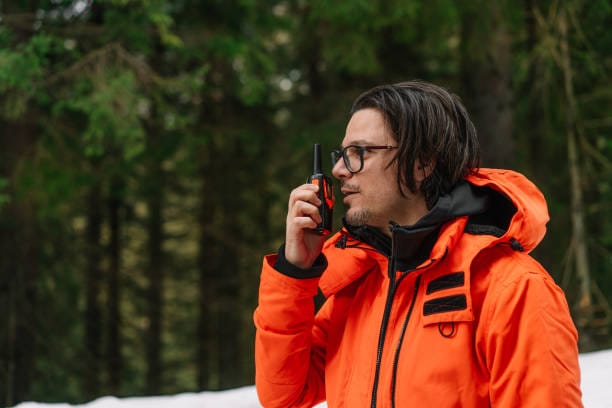
Walkie-Talkie Range by Environment
To provide practical conclusions, the following are some typical ranges depending on various environments:
| Environment | Consumer Walkie-Talkie | Commercial | Professional |
| Urban | 0.5–1 mile | 2–5 miles | 5–10 miles |
| Suburban | 1–2 miles | 5–10 miles | 10–20 miles |
| Open Field | 2–5 miles | 10–25 miles | 20–50 miles |
| Mountainous | 0.5–1 mile | 5–10 miles | 10–30 miles |
How to Increase Walkie-Talkie Range Easily
1. Move to higher ground
Elevating to the high point immediately enhances the line of sight, eliminating building or land blockage of the signal. A simple elevation or climb to a small hill can help to increase your walkie-talkie range by twofold.
2. Use a longer antenna
The performance of the signal can be significantly increased in the process of upgrading to a longer high-gain antenna. It improves the effectiveness of transmission, which means that you can use your walkie-talkie to communicate over a greater distance without additional power or complex technical solutions.
3. Keep the antenna vertical
The walkie-talkie antenna should always be erect to get the strongest signal. Radio waves are best transmitted vertically, and any slight tilting can decrease clarity, reduce range, range result in communication dropouts.
4. Use the correct selection of the appropriate frequency
Use the correct selection of the appropriate frequency enhancerange much better. VHF is the best in an external setting when there are few barriers, whereas UHF is better in an indoor setting where it encircles walls and structures and therefore has higher levels of power and clarity in transmission.
5. Avoid obstacles
Attempt to avoid structures, trees, cars, or metallic objects. Radio waves are captured and blocked by these objects, significantly lowering the range of walkie-talkies. An open path is clear and improves the performance of signals.
6. Use a repeater
Your signal is decoded by a repeater, which retransmits it over a greater distance, which then increases the communication range significantly. It is the most effective way of increasing reach, particularly in expansive localities or blocked locales.
7. Increase power
With a radio that has adjustable power, a range can be significantly extended by increasing power. Increasing power gives signals better penetration, though it would be advisable that it does not exceed the local regulations and the operating limits of your device.
Common Myths About Walkie-Talkie Distance
Myth 1: More watts always mean more range
The assumption that more power in watts is a sure indicator of more range is incorrect since terrain, obstacles, and the condition of the antenna are way more important. Even a strong radio will not be able to defeat mountains, structures, or heavily wooded forests that interfere with signals.
Myth 2: Indoor range should be the same as outdoor
It is practical that the range in indoor settings will be significantly lowered due to the absorption or reflection of radio waves by walls, metal frames, concrete, and electronics. Walkie-talkies are always better used in an open environment where signals are not heavily obstructed by structures.
Myth 3: All walkie-talkies reach the advertised distance
The ranges that are advertised are under ideal conditions, such as open water or mountain tops. The real-life conditions have barriers and distortions, therefore majority of the walkie-talkies only cover a small percentage of the stated maximum distance available in normal operations.
Conclusion
The range of walkie-talkies is very diverse in relation to the terrain, situational obstacles, and the quality of the devices. On the one hand, in ideal conditions, impressive distances are possible, but on the other hand, the performance is impaired in daily conditions. The knowledge of actual range constraints and simple fixes, such as improved antennas or elevation, will guide you to get even better communication, which could be clearer and more trustworthy.