
Learn Can You Find Radio Broadcast from a Walkie Talkie, and if you can find radio broadcasts from a walkie‑talkie, how scanners, SDRs, and frequency differences affect reception and detection of signals.
Radio communication has played an influential role in the technology of the modern world, having formed the mode through which individuals retrieve information and communicate. Radio broadcasts and walkie-talkies are two terms that are usually mentioned in this field. Although they are both based on the use of radio waves, they are used in diverse ways.
What is Radio Broadcast
Radio broadcast refers to the transmission of sound data, e.g., music, news, talk shows, or emergency messages, over a given frequency using electromagnetic waves to a mass audience. Broadcasts are usually one-way messages in that the sender transmits signals, and any person with a suitable receiver, such as a radio, can listen.
Key Features of Radio Broadcast
- Frequency-Based Transmission: Radio transmissions fit within designated frequency bands (i.e., AM (Amplitude Modulation), FM (Frequency Modulation), or digital (DAB, HD Radio)).
- Wide Coverage: Radio may have a local range in magnitude of the transmitter power regional to even national.
- Public Accessibility: The broadcast is accessible to any individual who has a radio receiver where it is set to the right radio frequency.
- One-Way Communication: In contrast to the phone or walkie-talkies, traditional radio broadcasts do not give the listener a response to the transmitter.
Can You Find Radio Broadcast from a Walkie Talkie?
Yes, it is possible to get a radio broadcast sometimes using a walkie-talkie, but the type of device used determines this. Standard walkie-talkies use definite UHF/VHF channels, and thus they are able to hear the transmissions passing in their frequency ranges. But they, as a rule, have no access to commercial FM/AM radio transmissions except in the form of hybrid radios. The matching of channels is necessary.
Types of Devices That Can Find Walkie‑Talkie Broadcasts
Standard Two‑Way Radios
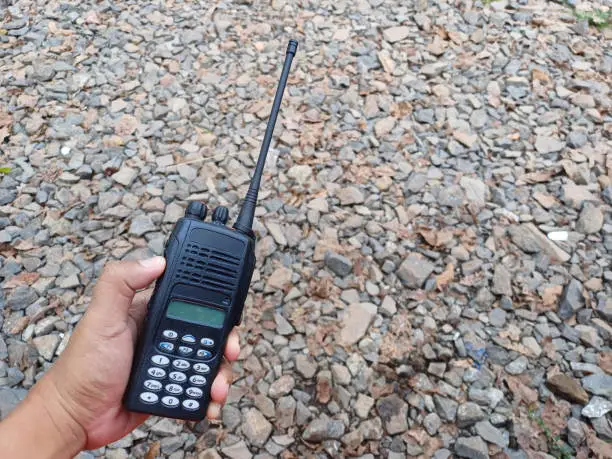
Simple walkie-talkies are capable of receiving some transmissions of other people using the same channel. When properly tuned, it can be used to communicate as long as the users are within the range of operation of the device.
Radio Scanners
Radio scanners will automatically search across several frequencies and halt at active channels. They also provide a broad spectrum, programmable channels, priority scanning, as well as digital decoding of both analog and digital walkie-talkies.
Software Defined Radio (SDR)
SDR monitors a wide spectrum through the use of a computer and a USB dongle. It translates multiple formats, logs traffic, and offers complex processing of walkie-talkie transmissions in an efficient way.
Why Walkie-Talkies Can’t Pick Up Standard Radio Broadcasts
- Frequency Range Differences: The AM radio frequency is 5301700 kHz, and the FM radio is 88- 108 MHz. Walkie-talkies operate at most with 400-500 MHz (UHF) or 136-174 MHz (VHF).
- Signal Processing: Walkie-talkies are not meant to decode broadcast signals to be used with standard radios, but rather to transmit voice signals between the devices.
- Modulation Differences: FM or AM modulation is commonly used in broadcast radios, whereas narrower modulation schemes are used to support two-way communications in walkie-talkies.
Factors That Affect Your Ability to Find a Walkie‑Talkie Signal
Range and Power
Walkie-talkies are limited in their range of transmission power. Signals may be diluted by distance, terrain, structures, trees, and interference, making it difficult to detect or accept broadcasts.
Frequency
Public or common frequencies are readily available, whereas the private or encrypted ones are hard and near impossible to access without the right authorization or gear.
Encryption
Encryption can be utilized in modern digital radios such as DMR or P25. Coded messages cannot be deciphered by a simple scanner; you may only see something being transmitted, but not audio.
Antenna and Equipment Quality
Good antennas and receivers improve the detection of signals. Better equipment enhances radio range, clarity, and the general effectiveness of finding and tuning walkie-talkie broadcasts.
Walkie‑Talkie Broadcast and Public Safety or Private Use
1. Personal/Consumer Use
Walkie-talkies are commonly used by individuals when they are out on a family trip, camping, and when kids are playing. FRS is an unencrypted common band that is used in consumer models and is appropriate for communicating at fairly short distances.
2. Commercial Use
Security, construction, and event management businesses have operations that are dependent on walkie-talkies in their coordination. Higher power radios and the use of personal repeater frequencies by some are used to ensure reliable communications over larger distances.
3. Public Safety and Government
Walkie-talkie-like radios with secured frequencies are used by firefighters, police, and EMS. Such gadgets can have encryption and legal safeguards that prevent any sensitive communication from being accessible to the masses.
Tools to Detect Walkie-Talkies
Radio Scanners
Handheld radio scanners can scan across a variety of frequencies, hence enabling users to monitor numerous walkie-talkie channels. They offer a convenient means of identifying active transmissions and determining the frequencies that are used in the immediate area.
Software-Defined Radios (SDR)
SDRs are general devices that can be used to visualize, record, and analyze radio signals with the help of a connection to a computer. They allow the detailed monitoring of the walkie-talkie communications and the ability to decode the signals within the frequency range of the device.
Directional Antennas
Directional antennas also direct the reception in a particular direction, and they help a user identify the origin of a walkie-talkie signal. With the rotation of the antenna, one can find out the origin of transmissions more easily.
Signal Strength Meters
Signal strength gauges are used to measure the strength of radio transmissions. Using the variation in strength as the equipment is moved or changed in position, users can approximate the distance and direction of a walkie-talkie signal source.
Common Misconceptions
Myth: Your Walkie‑Talkie Conversations Are Private
Most users are under the wrong notion that their walkie-talkie conversations are confidential. In an unsecured or unencrypted channel, any person within proximity who has a receiver of a similar nature can overhear any conversation with no technical limitations.
Myth: Encryption Makes It Impossible to Detect Transmissions
Encryption ensures the content of a transmission is secure, but not the signal. As viewers, one can still perceive that communication is being done even though he or she cannot decipher the message being relayed.
Myth: Higher Power Means More Privacy
The higher the transmission power of a walkie-talkie, the longer its range, which does not improve privacy. The signal can still be received by anyone within the extended coverage area, and no relation is available with the use of higher power in confidential communication.
Conclusion
Although both walkie-talkies and radio broadcasts are based on the use of radio waves, they are used in different ways. Walkie-talkies may pick up nearby transmissions, but are usually not able to pick up the standard AM/FM transmissions. To detect or monitor walkie-talkie signals, proper equipment, frequency matching, and knowledge of limitations are necessary.