
Learn about Can Walkie-Talkies Be Intercepted. Learn how walkie-talkies can be intercepted and ways to secure communications using encryption, privacy codes, and limited range.
Introduction
Intercepted is a process of intercepting or intercepting information, messages, or signals to a receiver without it being directed to the interceptor. In communications, interception is the act of listening to, observing, or recording communications without authorization, often with the result of loss of privacy or security, e.g., phone calls, email messages, radio signals, etc.
How Walkie-Talkies Work
Walkie-talkies use radio frequency (RF), which is electromagnetic radiation that can support voice signals over distances. They normally operate in VHF (Very High Frequency) or UHF (Ultra High Frequency).
- Analog Walkie-Talkies: These are voice transmissions at radio frequencies. Their conversation can be overheard by any person on the same frequency, and they are, therefore, prone to interception.
- Digital Walkie-Talkies: These encode voice into digital messages that are encryptable. Digital radios can utilize TDMA (Time Division Multiple Access) or other schemes to enable the sharing of the channel by more than one user without compromising the security of users.
The communication that is made possible by a walkie-talkie is half-duplex, implying that only one individual can speak, and the rest can hear. The design simplifies transmissions but does not necessarily protect the content against interception.
Can Walkie-Talkies Be Intercepted?
Yes, walkie-talkies can be intercepted. Because they are radio frequency, any person with a compatible receiver can theoretically listen, and therefore, insecure or non-secure radios are the most susceptible to this vulnerability. Encrypted devices should always be used in sensitive communication in order to avoid eavesdropping and in order to ensure the privacy of the message being transferred.
Factors That Make Interception Possible
1. Unencrypted Signals
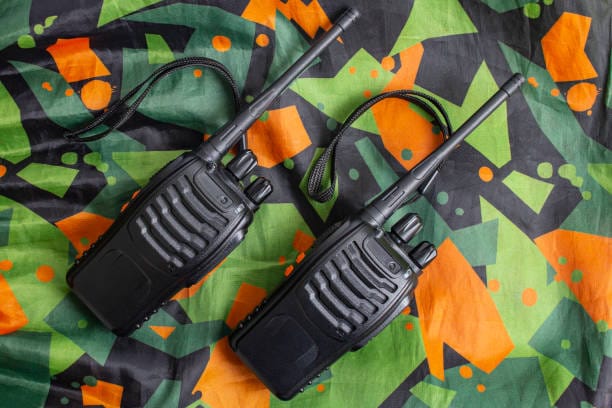
Most walkie-talkies, particularly consumer radios based on FRS or PMR446, are not encrypted. Owing to this, any person with a compatible receiver is able to intercept the communication.
2. Shared Frequencies
Walkie-talkies interfere with other gadgets in the same locality. When a neighbor is having a radio, he or she can easily intercept the transmissions.
3. Signal Strength and Range
Stronger radios with more wattage can be used over longer distances, and there is a higher probability that someone in the range can pick up signals.
4. Digital vs. Analog Signals
Radios that use analog are easier to intercept since the signal is sent in the form of sound waves. Digital radios can be even more secure with encryption or by use of digital coding, and interception can be possible but difficult.
Methods of Interception
1. Eavesdropping
The least complex form of interception. To listen to conversations, a listener tunes a scanner or other walkie-talkie to the same frequency.
2. Radio Scanners
Scanners that are used by police, emergency personnel, hobbyists, and certain security agencies have the capability of monitoring several frequencies at the same time. Such scanners are able to intercept unencrypted walkie-talkie traffic.
3. Signal Jamming and Sniffing
The advanced interception is signal sniffing, in which the attacker is able to obtain RF data, and in some cases, use software-defined radios (SDRs). These are devices that are able to analyze signals, decode them where digital, and in some instances, even replay them.
How to Prevent Walkie-Talkie Interception?
Use Digital Radios with Encryption
This is through the use of high-end digital walkie-talkies with strong encryption like AES 128-bit, which ensures your conversation is safe and your messages cannot be intercepted by unauthorized people in the network.
Enable Privacy Codes (CTCSS/DCS)
Turning on CTCSS or DCS privacy tones prevents other users on the air from overhearing you; only other users with the required permissions can access your conversations.
Use Less Common Frequencies
It is better to use channels that are used less often so that there are fewer chances of accidental or intentional interception, and your communications are more confidential than with commonly used standard frequencies.
Limit Transmission Range
Reduction of the transmission power of the radio limits the range of the signals, thus minimizing chances of interception by other distant or unintended receivers, yet still being able to communicate effectively locally.
Avoid Sharing Sensitive Information
Use analog radio messages like they can be monitored and do not transmit confidential or sensitive information, using secure means where sensitive messages should be preserved.
Conclusion
Walkie-talkies are interceptable, particularly non-encrypted analog devices with a common frequency. Encryption of digital radios, privacy codes, use of less frequently used channels, and reduced transmission range go a long way towards improving security, which is useful in preventing sensitive communications from being intercepted by others.