
Learn about Would Walkie-Talkies Work on Mars. Discover if walkie-talkies can work on Mars and the specialized tech needed for reliable communication in harsh Martian conditions.
Introduction
Walkie-talkies refer to two-way radios that are handheld and enable the user to communicate with someone in a very small area without the use of cellular networks. Radio waves are transmitted and received by them using radio waves and are propagated by the air at the speed of light. Walkie-talkies are becoming very popular in hiking, emergency services, construction sites, and recreational events because they are simple, portable, and do not require any infrastructure.
Would Walkie-Talkies Work on Mars?
Yes, walkie-talkies would work on Mars because such devices use radio waves, which can travel through the thin atmosphere of the planet and the near-vacuum environment. However, their coverage would be minimal, and communication would need specialized, space-grade equipment that can withstand harsh temperatures, dust storms, and the rough Martian landscape so that it can be used on a regular and dependable basis.
What factors affect Walkie-Talkies on Mars?
Radio waves travel through a vacuum.
Radio waves need a medium, such as air, in order to propagate best. On Mars, the vacuum and the thin atmosphere suppress the signal, and this fact lowers the effectiveness of communication over a long distance.
Limited range
Planetary terrain and low atmospheric density of the Martian environment can greatly decrease the range of the walkie-talkies, making reliable communication on a short scale, unless the walkie-talkies use high-powered communication devices, or the planet features a relay system.
Obstructions
Radio signals can be blocked or reflected by mountains, craters, and dust storms on Mars, resulting in dead zones and signal degradation, making direct line-of-sight text communication with walkie-talkies difficult.
Need for specialized equipment for long distances.
Normal walkie-talkies are inappropriate on Mars. To ensure communication over long distances, special high-gain antennas, repeaters, or satellite relays are needed.
Space-grade devices
Mars requires equipment that can survive the extreme temperatures, radiation, as well as dust storms. Space-rated walkie-talkies are only substantially reliable to operate in such harsh environmental conditions.
Innovations for Mars Communication
Engineers and scientists are experimenting with how to improve the use of walkie-talkies in extraterrestrial missions:
1. Space-Grade Radios
Other space agencies, such as NASA, are coming up with hardened radios with ruggedness, which are particularly used in missions to Mars. These gadgets are temperature and dust-resistant as well as power-efficient.
2. Satellite Relays
The implementation of a small relay satellite in the orbit of Mars could widen the scope of the walkie-talkies to have a wider range in communication between the scattered crew members and the bases.
3. Hybrid Systems
The Martian walkie-talkies can also be used in combination with the rover networks and automated relays, and a hybrid system can also be developed that can make the most of short-range and long-range communication.
4. Autonomous Repeaters
Communication repeaters that are fixed on the surface of Martian terrain might be positioned strategically to eliminate barriers such as canyons, cliffs, and volcanoes so as to provide reliable coverage of the walkie-talkies.
Lessons from Mars Missions
Previous and current missions to Mars give some understanding of communication issues:
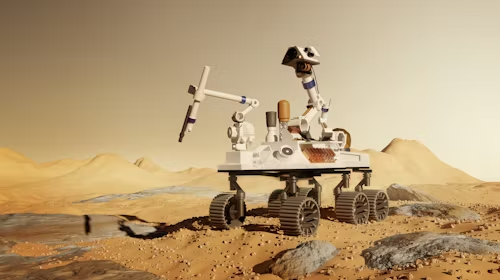
- Mars Rovers: Rovers such as Curiosity and Perseverance are data relaying through orbiting satellites. Physical contact cannot be made with the Earth because of distance and latency.
- Simulated Mars Environments on Earth: The simulated environments on Mars Mars Experiments Scientists test communications equipment in harsh simulated conditions by building analogs on Earth, including deserts and volcanic regions.
- Human Missions to the Moon: The Artemis experience with extreme temperature and radiation can inform engineers to build walkie-talkies for the exploration of Mars.
Challenges of Communication on Mars
Atmospheric Conditions
The thin, carbon dioxide-filled atmosphere of Mars enables the radio waves to propagate with a low absorption rate; however, since the pressure is low and the medium is not dense then there is a possibility that the signal stability will not be stable over the long distance.
Distance and Terrain
Radio signals are blocked or reflected depending on the extreme Martian landscapes, which include mountains, canyons, and plains. The range of the walkie-talkies is limited based on the direct line of sight, with the obstructions in the terrain significantly lowering the efficiency.
Temperature Extremes
The temperatures inside Mars are between -125 o C and 20 o C, which is way above the normal walkie-talkie limits. There can be a failure of batteries, circuits, and antennas, and to provide good communication, specialized devices are needed.
Dust Storms
Week-long planet-wide Martian dust storms may put line-of-sight radio communications at a disadvantage, and unprotected electronics may be ruined. There should be space-grade shielding and hardened devices to enable safe, reliable operation.
Potential Scenarios for Martian Walkie-Talkies
To consider the possible real situations in which walkie-talkies would come in handy on Mars, let us take a look at some of them:
Scenario 1: Inside a Mars Base
Walkie-talkies could be used between rooms, greenhouses, or workspaces by astronauts in a habitat or base. The devices would work effectively because the obstacles are restricted indoors.
Scenario 2: Extravehicular Activity (EVA)
When making EVAs, astronauts could communicate with the base or with one another using walkie-talkies as they explored the surroundings. The distance could be increased using special antennas or relay stations to achieve safe coordination over rocky terrain.
Scenario 3: Emergency Communication
Walkie-talkies might be a backup tool in the event of a failure of primary communication systems in case of an emergency. Their simplicity and immediate connection are the best in making them suitable in emergencies where other communication tools may fail.
Conclusion
Walkie-talkies would be functional on Mars; however, specialized equipment, space-grade, would be required. Their short distance, high temperature, dust storms, and rough terrain necessitate sophisticated antennas, repeaters, or hybrid equipment to provide reliable and high-quality short and long-distance communication to the explorers.