
Learn about What Walkie-Talkie Does the Military Use. Learn which walkie-talkies the military uses, featuring secure, long-range tactical radios built for combat and encrypted communication.
The military systems of communication are much more sophisticated than the normal walkie-talkies used by consumers. Although they are commonly known as walkie-talkies, the gadgets employed by the military are safe tactical radios that are combat, encrypted, connective over a long distance, and mission-critical. These radios have to be resistant to extreme weather, fighting stress, electronic warfare, and signal jamming- they are very unlike the tools of communication in the civilian world.
Why the Military Doesn’t Use Normal Walkie-Talkies
The walkie-talkies used by civilians typically run on small UHF/VHF frequencies with low range and no encryption; that is, anyone may listen.
- Secure communication (encrypted)
- Long-range connectivity
- Resistance to jamming
- GPS integration
- Data + voice communication
- Durability in extreme environments
Due to these requirements, the military finds application of tactical radios and not the consumer walkie-talkies.
What Walkie-Talkie Does the Military Use?
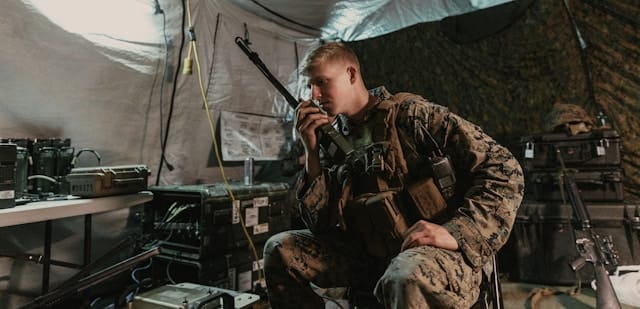
The military operates state-of-the-art tactical radios rather than walkie-talkies. These are models such as the Harris AN/PRC-152A, AN/PRC-117G, and Thales AN/PRC-148 that include an option to encrypt communication, long-range, anti-jamming technology, and extreme durability. Such safe radios make sure of secure communication during a battlefield in dangerous missions.
1. Harris AN/PRC-152A
The most common example of a handheld tactical radio with encrypted communications, a long range of use, support of SATCOMs, the strong durability. Perfect with ground troops requiring a secure and reliable means of communication on the battlefield.
2. AN/PRC-117G
It is an all-inclusive high-bandwidth radio that offers long-range connectivity, manpower, satellite connectivity, and high-level encryption. Widespread in mission-critical use in cars and on the battlefield.
3. Thales AN/PRC-148
A small-scale multiband handheld radio that provides secure voice communication, the ability to support numerous frequencies, and powerful encryption. Lightweight, reliable communication over a wide range of mission environments is popular among special forces.
Key Features of Military Walkie-Talkies
Military radios have advanced technologies that are not on commercial types:
1. End-to-End Encryption
Military radios employ end-to-end encryption, which is highly sophisticated and therefore only users are supposed to listen. This avoids interception of enemies and keeps the mission details, troop movement, and strategic information totally safe under any circumstance.
2. Spread-Spectrum Technology
The spread-spectrum technology transmits the signal in various frequencies, and this makes communication difficult to intercept or jam. This system enhances reliability in combat areas with high interference and guarantees that messages are sent to troops without being distorted and losses of signals.
3. Satellite Connectivity
Through satellite connection, soldiers can communicate with each other even across continents, mountains, deserts, and distant battlefields. Radio, seven without towers or a local network, has a strong, secure network to command centers to update missions and coordination on the emergency response anytime.
4. Secure Frequency Hopping
Secure frequency hopping quickly changes channels in transmission, so that enemies cannot lock onto the signals. The method enhances the security of communications, minimizes risks of tracking, and provides a high-security standard of delivering messages in electronic warfare and hostile conditions.
5. GPS and Blue Force Tracking
GPS and Blue Force Tracking are integrated to give the real-time position of the troops to the commanders. This improves coordination, minimizes risks of friendly fire, improves awareness of the battlefield, and provides quicker decisions since the exact positions of friendly units are shown.
6. Long Battery Life & Extreme Durability
Military radios are characterized by long-lasting batteries and tough construction that is resistant to extreme climatic conditions. They are shockproof, waterproof, dust-resistant, and heat-tolerant, which makes them reliable in communication during prolonged missions in harsh and unpredictable war environments.
Differences Between Military Radios and Civilian Walkie-Talkies
| Feature | Civilian Walkie-Talkie | Military Tactical Radio |
| Encryption | None | Strong military-grade |
| Range | 1–5 miles | Dozens of miles + satellite |
| Build | Plastic | Shockproof, waterproof, battlefield-grade |
| Data Transfer | No | Messaging, GPS, video |
| Anti-Jamming | No | Yes |
| Price | $30–$200 | $5,000–$20,000+ |
What Frequencies Do Military Walkie-Talkies Use?
The military uses:
- VHF (30–300 MHz)
- UHF (300–3000 MHz)
- HF (3–30 MHz)
- SATCOM frequencies
- Encrypted digital bands
These are limited frequencies that can not be legally operated by civilians.
Are Military Walkie-Talkies Legal for Public Use?
Generally, no. These radios require:
- Military licensing
- Encryption clearance
- Government approval
- Limitations of restricted frequencies are permitted.
The possession or use of unlicensed models may lead to:
- Penalties
- Confiscation
- Legal action
There are also declassified or civilian versions, but they lack military encryption or tactical functionality.
Civilian Alternatives That Resemble Military Radios
Although civilians are not legally allowed to have real military communications devices, there are comparable rugged radios, including:
1. Motorola T-Series (Rugged Models)
The Motorola T-series radios are robust, convenient to carry and use, and are outdoor devices. They have long battery lives, a good range, and hard construction that allows them to be a viable and economical civilian alternative to military-style devices.
2. BaoFeng BF-F8HP or UV-82 (Licensed Use Required)
BF-F8HP and UV-82 are both good and provide good performance and a wide frequency range, but are in need of a proper radio license. They lack encryption, thus cannot resemble what real military communication entails.
3. Midland GXT Series
Midland GXT radios make use of GMRS frequencies and can be used in hiking, camping, and emergencies. They are good in range, weather-resistant resistant and easy to use, hence easy outdoor communication tools.
4. Rugged Retevis Two-Way Radios
Retevis rugged radios are constructed for rough and rugged environments, which are waterproof and shockproof. They offer dependable communication to use during adventure, work locations, and even in case of emergencies, yet they still do not have the encryption and security offered in case of military operations.
Reasons why Walkie-talkies are relevant in the Military now more than ever
1. Faster Communication
Walkie-talkies are instant and offer real-time communication without the use of the internet or cellular networks. This pace is essential when on missions because it allows soldiers to organize fast, exchange information, and react instantly in stressful combat scenarios.
2. Durable
Military walkie-talkies are constructed using rugged and battlefield-ready materials that are immune to explosions, extreme temperatures, dust, water, and shock. They are also durable enough to maintain communication under extreme conditions, which other gadgets cannot easily fail.
3. Better Battery
In contemporary military radios, the batteries are long-lasting and can be used in long missions without the need to charge them frequently. They are programmed to last a number of hours, and therefore, they enhance constant communication even when performing long-term missions in distant or hostile locations.
How Far Can Military Walkie-Talkies Reach?
Depending on the kind of radio:
✔ Handheld radios (PRC-148)
Military handheld radios generally have a range of 5-10 miles and provide secure communication depending on the terrain, obstacles, and the situation of the mission.
✔ Manpack radios (PRC-117)
Manpack tactical radios have a range of 20-30 miles with good long-range communications, which can even be extended to more miles in case connected to a satellite system.
✔ Vehicle radios (SINCGARS, etc.)
Mobile military radios mounted in vehicles have a range of 30+ miles and provide high-powered communication over a stable range that is perfect in situations where fast-moving units are spread out over a large battlefield.
Conclusion
The military agencies do not use the standard walkie-talkies; they have secure and encrypted tactical radios that have been designed with long-range, anti-jamming features and high durability. These are hi-tech communication technologies that will provide dependability, safety, and mission success in the most hostile of battlefield conditions.