
Learn about What Walkie-Talkies Do Police Use. Discover the walkie-talkies police use, including Motorola, Kenwood, and Harris, built for secure, long-range, mission-critical communication.
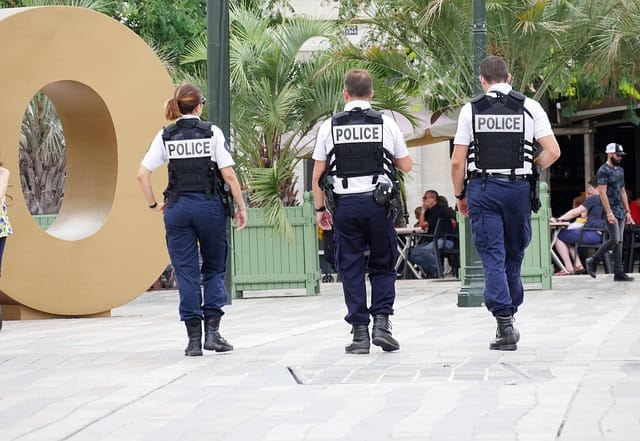
Walkie-talkies play a major role in contemporary policing. Police officers rely on such radios on a daily basis, whether they have to get to the scene due to an emergency, coordinate in the field, keep the traffic, communicate during patrols, or during a large event. Without the walkie-talkies, then communication in a fast and reliable manner would be almost impossible, especially during situations of high stress or even dangerous ones.
In layman’s terms, police walkie-talkies refer to professional two-way radios that operate on the principles of secure, long-range, durable, and instant communication between officers and departments. They are also constructed much tougher and smarter than ordinary consumer walkie-talkies.
What Walkie-Talkies Do Police Use?
Radios that are most commonly used by the police are made by Motorola, Kenwood, and Harris. The maker of these brands produces rugged, safe, and high-performance walkie-talkies that are specially designed to work in public safety.
Major Brands of Walkie-Talkies Used by Police
1. Motorola
Motorola walkie-talkies are widely used by the police due to the high level of security through encryption, a long range, good audio quality, and tough construction. Renowned models such as the APX series offer multi-band options, GPS, and assured performance during critical events.
Why police like Motorola:
- Good tone of voice even in crowded places.
- Stable encryption of secure communication.
- Exchangeable with dispatch centres.
- Strong battery life
- Water-resistant and heat-resistant.
- Long-range communication
- Functions on multi-frequency and digital.
The police use Motorola radios in the USA, the UK, Canada, Australia, and Europe, and in most Asian countries.
2. Kenwood
Many police departments have placed their trust in Kenwood radios because they produce clear sound and can withstand usage, in addition to being cheap to buy. Such models as the NX series provide digital communication, noise reduction, and reliable coverage of urban and rural operations.
Why the police chose Kenwood:
- Excellent audio clarity
- Strong build quality
- Affordable maintenance
- Easy programming
- Both digital and analog works.
Smaller police and non-government security agencies, fire departments, and EMS teams frequently use Kenwood radios.
3. Harris
The police and tactical operations that involve high security utilize Harris walkie-talkies. They are military grade, multi-band, long battery run, and highly reliable, making them suitable when deployed in emergency response missions and facing critical mission requirements.
Why the police chose Harris:
- Encrypted communication on a higher level.
- Applied in federal and military operations.
- Highly resistant to interference.
- Covering several frequencies.
- Construction made to survive in extreme conditions
Harris radios are common in SWAT teams, federal police, and some other agencies that need extra security.
How Police Walkie-Talkies Work
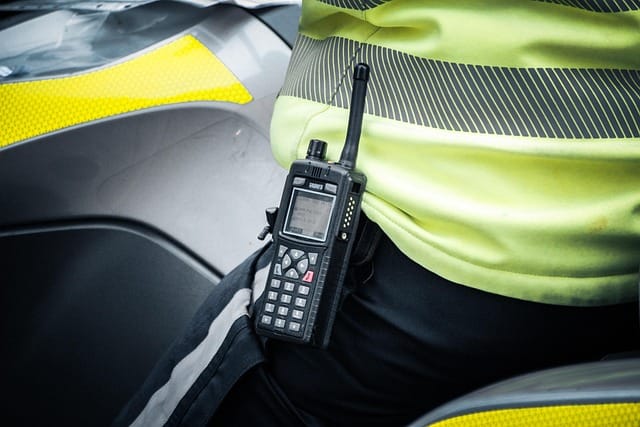
Radio frequency signals on the police radios are voice. When an officer pushes a button known as the PTT (Push-to-Talk), his radio encodes the voice into radio waves, which are then transmitted to other radios on the same frequency.
Key points of how they work:
✔ Two-Way Communication
In real time, officers are able to talk and listen to one another. The communicated message is received immediately by everyone on the same channel.
✔ Dedicated Police Frequencies
The police radios operate at the UHF or VHF bands, as well as special government frequencies. This makes discussions confidential to the media.
✔ Encrypted Systems
In the current walkie-talkies, there is a digital encryption such that no external party can overhear the conversation.
✔ Radio Repeaters
To expand the distance, the police networks deploy repeaters- towers that enhance the signals to reach extensive distances.
✔ Dispatch Centers
All the communication is handled by a central police control room, where the dispatchers organize work.
Why Police Need Special Walkie-Talkies
Police radios are not merely ordinary walkie-talkies since they are expected to operate under conditions where other communication can fail. Officers need radios that:
- Disaster work or power failures.
- Interconnect over long distances using cities and rural locations.
- Network with various departments (fire, EMS, rescue teams).
- Offer safe, encrypted communication.
- Remains operational following drops, rain, dust, and extreme temperatures.
- Endure a lengthy battery life of 12-15 hours.
- Provide real-time push-to-talk.
- Advanced features such as GPS, emergency alerts, and noise-cancelling are supported..
So, police departments are using professional two-way radios designed to be used in mission-critical communications rather than the walkie-talkies that are of consumer quality.
What Makes Police Walkie-Talkies Different?
1. Encrypted Communication – 30 Words
Strong encryption is applied the police walkie-talkies to preserve confidential information such as addresses, suspects, and operations. This prevents outsiders from listening, which is not the case in consumer radios, which may be easily scanned and intercepted by unauthorized individuals.
2. Long Communication Range
Radio sets allow communication among police in cities, forests, highways, mountains, and buildings. They cover a distance of many miles with repeaters, and so as long as officers are connected, even in areas with poor accessibility, where the normal walkie-talkies fail to go.
3. Advanced Frequencies
VHF, UHF, 700/800 MHz, trunked systems, EM, S, and P25 digital networks are the advanced frequencies used by police. These have more range, high-quality audio, better communication safety, and better performance compared to those of the ordinary walkie-talkie frequencies.
4. Durability and Rugged Build
The police walkie-talkies are waterproof, shock-resistant, heat-resistant, and made of long-lasting batteries. The rough construction allows them to survive falls, extreme weather, nd every day in the line of duty during difficult law enforcement tasks.
5. Compatibility With Dispatch Systems
Police radios are connected to 911 centers, dispatch computers, GPS, car radios, repeaters, and communication towers. This also guarantees seamless organization, quick updates, and effective coordination within the whole city and the departments.
6. Emergency Buttons
The police radios have a panic button that transmits an immediate emergency signal to the headquarters. It also triggers the location tracking and alerts nearby officers to assist in offering faster backup, and enhances the safety of the officers when faced with threats.
Police Walkie-Talkie Features Explained Simply
1. P25 Digital System
P25 provides officers with easy communication, security, and great encryption regardless of the location, providing a secure, reliable, and smooth radio operation.
2. Trunking
Trunking allows two or more agencies to effectively share radio frequencies, where traffic management is fully automatic to ensure communication remains clear, neat, and devoid of channel overload.
3. GPS Tracking
GPS navigation provides the live position of every officer to aid in dispatch in coordination of responses, enhance safety, and coordinate teams better during missions.
4. Bluetooth and Wireless Connections
Bluetooth enables the officers to communicate using wireless headset, microphone, and speaker mics, and therefore communication becomes hands-free, flexible, and easy when the officer is on duty.
5. Noise Cancellation
Noise cancellation eliminates the presence of background noise in the crowds, traffic, wind, and emergencies,,s and allows officers to hear and speak effectively in the noisy environment.
6. Multi-band Operation
Multi-band radios utilize various forms of frequencies, allowing the police to communicate with various teams, agencies, and networks in a single dependable and versatile device.
Why Police Don’t Use Mobile Phones for Communication
- Phones are not instant: Mobile phones need to be dialed and connected, and walkie-talkies are instant push-to-talk communications that are required in an emergency for the police.
- Phones depend on cell towers: There is always the failure of cell networks in disasters or congestion, whereas police walkie-talkies are independently practiced over radio frequencies and repeaters with great reliability.
- Security issues: Hacking or interruption of mobile phones is easy, and police walkie-talkies have powerful en,,c encryptedchannels to secure sensitive communication during operations.
- No group communication: Phones do not enable sending messages to several officers at the same time, whereas walkie-talkies enable real-time communication with the group to coordinate the activities fast.
Challenges Police Face with Walkie-Talkies
Some challenges encountered by the police using the walkie-talkies include signal interference in areas with a large population or even high buildings, high cost of equipment, short battery life with long shifts, and also requires training. The reliability of communication during critical operations can also be influenced by weather, distance, as well as technical problems.
Conclusion
Police walkie-talkies are essential tools that provide secure, long-range, and instant communication in every situation. Brands like Motorola, Kenwood, and Harris deliver the durability, encryption, and reliability officers need. These radios ensure smooth coordination, faster response, and safer operations in daily and emergency duties.