

Learn about Do walkie-talkies work through walls. Learn how signals travel, what affects range, and which radios work best indoors.
Walkie-talkies are two-way radios, which are portable and allow individuals to talk in real-time with others over a short distance through radio waves. They operate offline, thus they can be used at home, school, events, security, hiking, and emergencies. Every device is equipped with a speaker, microphone, antenna, and push-to-talk button to allow quick, precise communication at any point.
Do Walkie-Talkies Work Through Walls?
Yes, walkie-talkies can indeed pass through the walls, and this is based on the type of radio and the wall material. Thin walls do not create much interference, and thick concrete, metal, or brick walls may attenuate or attenuate signals. Better UHF or digital radios are more effective in buildings since they are clearer of the obstacles than the simple consumer models.
How Walkie-Talkies Work Through Walls
Walkie-talkies involve the transmission and reception of messages via radio waves. Radio waves have the ability to go through numerous barriers, such as walls, floors, and doors. Not every material can, however, conduct signals equally well.
What Materials Affect Walkie-Talkie Signals?
1. Wood – Minimal Interference
The walkie-talkie signals are only slightly weakened by wood. Most handheld radios do not have many problems with the wooden houses or cabins since wood is not an effective absorber or blocker of radio frequencies.
2. Drywall – Very Little Signal Loss
Drywall amounts to practically no interference with walkie-talkies. Standard interior walls enable signals to travel without difficulties, and communication within homes or offices is usually clear and dependable.
3. Brick – Moderate Interference
Radio waves are absorbed by the brick walls, causing the total range to be less. Thick brick constructions of buildings generate weaker signals, particularly when two or more brick walls are between two radios.
4. Concrete – Strong Interference
Physically, Concrete is a great shield to radio waves, particularly where it is heavy or supported. Poor performance of the walkie-talkie in basements, parking garages, and in large concrete buildings is usually the result of massive signal loss.
5. Metal – Major Interference
Radios are highly reflected and blocked by metal. Warehouses, metal structures, elevators, and steel doors are the main communication barriers, and in most instances, walkie-talkies cannot effectively operate through them.
6. Glass – Minimal Interference
Frequent glass hardly blocks signal power, and radio waves do not have difficulties in passing through. Glass can, however, be colored or sprayed, or strengthened to weaken the range by blocking or reflecting radio waves partially.
7. Plumbing, Wiring, and Appliances – Interference
Electromagnetic interference caused by pipes, electrical wiring, microwaves, and large appliances can interfere with walkie-talkie signals. Such items in the walls may undermine clarity or minimize indoor communication distance.
Do walkie-talkies work through walls in offices or schools?
Drywall, glass, and brick are mostly used in most offices and schools. The walkie-talkies can be used, but the distance is shortened. Besides, numerous electronic devices in offices can lead to minor disruption.
The walls of large structures such as universities, hospitals, libraries, and commercial centers are more solid with more floors, making the walkie-talkie performance less predictable.
Do walkie-talkies work through walls in malls or warehouses?
They are larger with more barriers in these buildings. There can be metal shelves, steel beams, and machines in warehouses. Malls can contain solid concrete parts.
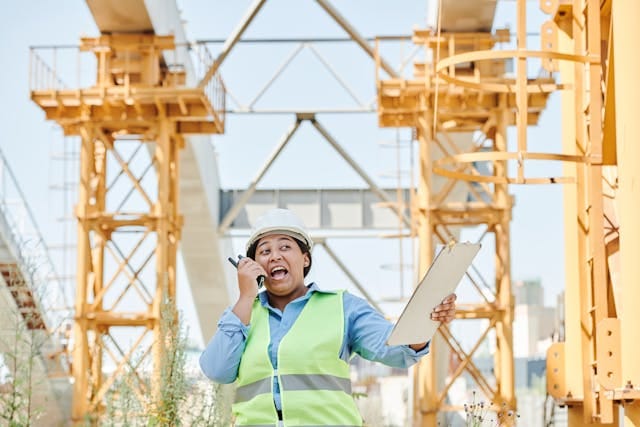
The walkie-talkies are not obsolete, and in some areas or behind huge metallic objects, there can be signal loss. In these locations, the security groups tend to utilize UHF business walkie-talkies since UHF is more effective inside a building.
Tips to Improve Walkie-Talkie Performance Through Walls
✔ Use UHF radios for indoor communication
The walkie-talkies in UHF are more effective indoors since their short wavelengths can into buildings. They give better clarity and higher consistency when used at home, in offices, and in congested indoor conditions.
✔ Choose higher wattage radios
Radios that have more watts put off a stronger signal, which can reach a distance and penetrate walls with ease. Greater power is beneficial in keeping the building clear, particularly the buildings that are thick or dense.
✔ Avoid standing behind metal objects
Radio waves are reflected and blocked by metal surfaces. Being behind metal doors, shelves, vehicles, or equipment weakens transmission; thus, maintaining a clear passage enhances communication.
✔ Stay away from electronic interference
Electromagnetic interference is also created by devices such as microwaves, generators, and heavy machines that interfere with the transmission of signals. Distancing such equipment will provide better audio and help avoid the dropouts during the communication process within buildings.
✔ Use repeaters for large buildings
The radio repeaters amplify the signal strength and coverage of large buildings like malls, warehouses, hotels, and hospitals. They are used to break the walls, floors, and distance, making the two-way communication reliable.
✔ Keep the antenna vertical
When the walkie-talkie is held with the antenna straight, the signal efficiency peaks as much as possible. This placement enhances wall penetration and leads to better and more stable communications between radios.
Real-life examples of walkie-talkies working through walls
Homes
Walkie-talkies can easily penetrate bedrooms, kitchens, living rooms, stairs, and floors to give clear communication within most houses that are made of wood or dry walls.
Schools
Radios operate across halls, classrooms, offices, and staircases and can provide a good communication means among employees, but heavy concrete floors can partially attenuate signals.
Malls
Walkie-talkies operate throughout the shops and storage rooms, although metal shutters, lifts, or massive steel buildings may decrease clarity or restrict range in some areas.
Hospitals
Radios will not work in patient rooms and corridors, although thick concrete, equipment rooms, and basement levels can weaken the signal strength or even eliminate it.
Hotels
Numerous guest rooms and hallways signal pass through; however, the high fire doors, concrete characteristics of the floor, and strong walls can reduce the performance of walkie-talkies at various levels.
Why Do Some Walkie-Talkies Work Better Through Walls?
1. Power Output
Walkie-talkies that have greater wattage produce a more powerful transmission that goes through the walls. Four- to 10-watt models perform better than the low-power family radios within buildings.
2. Antenna Quality
Good-quality antennas enhance the signal strength and stability, which enables the radio waves to pass through barriers with better performance and enhances communication within homes, offices, and large buildings.
3. Professional vs. Consumer Radios
The high-quality radios used by police, security, as well as those employed by retail employees, are of professional quality and thus better when operating in an indoor setting than the basic consumer models, as they are more wall-penetrating and reliable in communication.
Why Some People Think Walkie-Talkies Do Not Work Through Walls
Others try to use the walkie-talkies in buildings and have poor performance. They might assume that the answer to the question Do walkie-talkies work through the walls? It is in the negative. Theft, the reason is:
- low-power cheap walkie-talkies
- too many concrete walls
- metal barriers
- long distance inside large buildings
- Incorrect frequency band
With proper devices, the answer becomes yes.
Which Type of Walkie-Talkie Is Best for Working Through Walls?
To answer the question: Do walkie-talkies work through walls?, the strongest yes would be:
- UHF walkie-talkies
- high-power models (4W–10W)
- professional or business radios
- long antennas
- radios with repeater support
Conclusion
Walkie-talkies are wall-friendly, but their functionality depends on the materials of the walls, power output, and radio quality. High-power and UHF models are effective in an indoor room. Used properly and equipped with the right gadgets, walkie-talkies are the best means of communication around the home, school, warehouse, and other large edifices.